Cutting down a tree is a difficult decision to make. Mature trees take decades to grow and once removed, are gone for good. However, there are cases where the best thing to do for your property and safety of your loved ones is to remove the tree from the property. Tree Service DFW offers professional tree removal services anywhere in the DFW metro area, removing anything from small ornamental trees to big oaks and pecans in backyard settings.
Not all diseased or dying trees require removal from the property. Most of the problems with such trees can be fixed by pruning, tree cabling or treating them. However, there are several reasons why tree removal is required:
As soon as a tree dies, it becomes very fragile and may drop huge branches or even fall down suddenly. Signs of dying or dead trees include absence of leaves or buds during the growing season, peeling of bark and no growth during the spring.
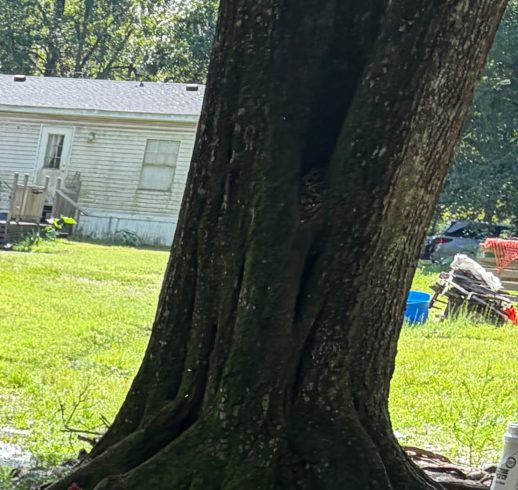
This means presence of cracks, deep cavities in the trunk, fungus in the trunk or on the ground close to the trunk of the tree and the trunk itself is soft or crumbling.
While some trees may be naturally inclined, those that start to lean suddenly should be looked at. Such trees usually develop cracks or raise soil at the bottom of the trunk which indicates possible root failure.
After a storm passes, sometimes trees sustain very heavy damage when their trunk gets split or part of their canopy gets torn away.
One of the most serious threats for trees in North Texas is oak wilt disease. Red oaks get infected very quickly and die; removal of the infected red oak tree helps to prevent further infection of the healthy neighboring trees.
When planted too close to the house, trees may cause damages to the foundation, roof and gutters. Also, their roots are able to crack driveways and walkways, invade sewer lines and cause lots of inconveniences.
If you are unsure, contact us and we will give you an opinion. If the tree can be saved, we will advise you of that.
North Texas region has its own unique set of trees, and some of them tend to develop health problems sooner or later. One of the most commonly seen trees requiring removal in our service area is a Bradford pear tree. It grows fast, but has very poor structure of its branches and tends to split into pieces during storms. Another common tree that requires removal from the property is a hackberry tree. It is usually found along the fence lines and at the base of the foundation, and is also very prone to rotting. Some of the other common types of trees in the metro are cedar elm, live oaks, red oaks, pecans and ash trees. All of them develop problems due to drought, diseases or storm damages.
The specific conditions of the region itself put stress on trees. Very heavy clay soils swell when saturated and contract when dry, which weakens the roots of the trees. Long summers make them very prone to diseases and pests. Spring storms with strong winds test their resistance to damages.
Every case is different, but our tree removal process remains the same:
First we inspect the tree and the surroundings. We measure the height of the tree, check its inclination, condition and other aspects as well as surroundings – house, fence lines, power lines, swimming pools, garden beds and other things. Based on the inspection results, we provide you with a written estimate describing the services and their price.
Very rarely, large trees can be felled in one piece in the residential area. We plan the removal process, determining where to make cuts and where to land each section of the tree.
When the limbs hang over the roof or fence, we use the ropes and rigging to lower heavy parts slowly and under control instead of just dropping them off. We proceed with utmost care while working in proximity to the lawn, beds and hardscape areas.
We start with the removal of the limbs and then fell the trunk of the tree in sections. If there is enough space available, the whole tree can be felled in bigger sections.
Branches get chipped and logs are loaded and removed from the property. If you would like to have some firewood or wood chips for mulching, we will be glad to provide them.
After the tree is removed, a stump remains. We grind it under the ground level and leave you space to re-plant or lay sod.
Every job is priced individually due to the difference of each particular tree. The major factors affecting the cost of tree removal are:
The bigger tree is, the higher price will be as it requires more time, labor and equipment.
The easier access and location of the tree, the cheaper it is to remove it.
Presence of houses, power lines and other obstacles increases the amount of rigging required.
Dead or decayed tree requires additional precautions and work.
Our written estimate will specify everything and will help you to know in advance what services are included in the price.
Even though it might seem easy to grab a chainsaw and remove a tree from the property, tree removal is one of the riskiest jobs that a homeowner can perform. Trees are very heavy, and do not necessarily fall the way you expect them to. Unexpected kicks of the trunk, unexpected movements of the limb and sudden breaking of decaying wood may cause serious damage to the house, car or your neighbor’s property. Never try to remove a tree or any of its branches which are in contact with power lines. Notify your utility company first.
Some of the cities in the Dallas-Fort Worth metro area have tree ordinance, regulating the removal of some specific trees. In many cases, this relates to removal of big trees and also to commercial property or undeveloped land. Many HOAs also have tree ordinance. Before starting the work, it is better to check with your city and HOA. We are ready to assist you in understanding what questions to ask.
Tree Service DFW provides tree removal services all over the Dallas Fort Worth metro area, including Dallas, Fort Worth, Arlington, Plano, Frisco, Irving, Garland, Grand Prairie, McKinney, Denton, Carrollton, Richardson, Mansfield and surrounding communities.
If you have a tree that is dead, damaged, leaning or is simply in the wrong place, we are happy to help you. Call Tree Service DFW today to schedule your free estimate.